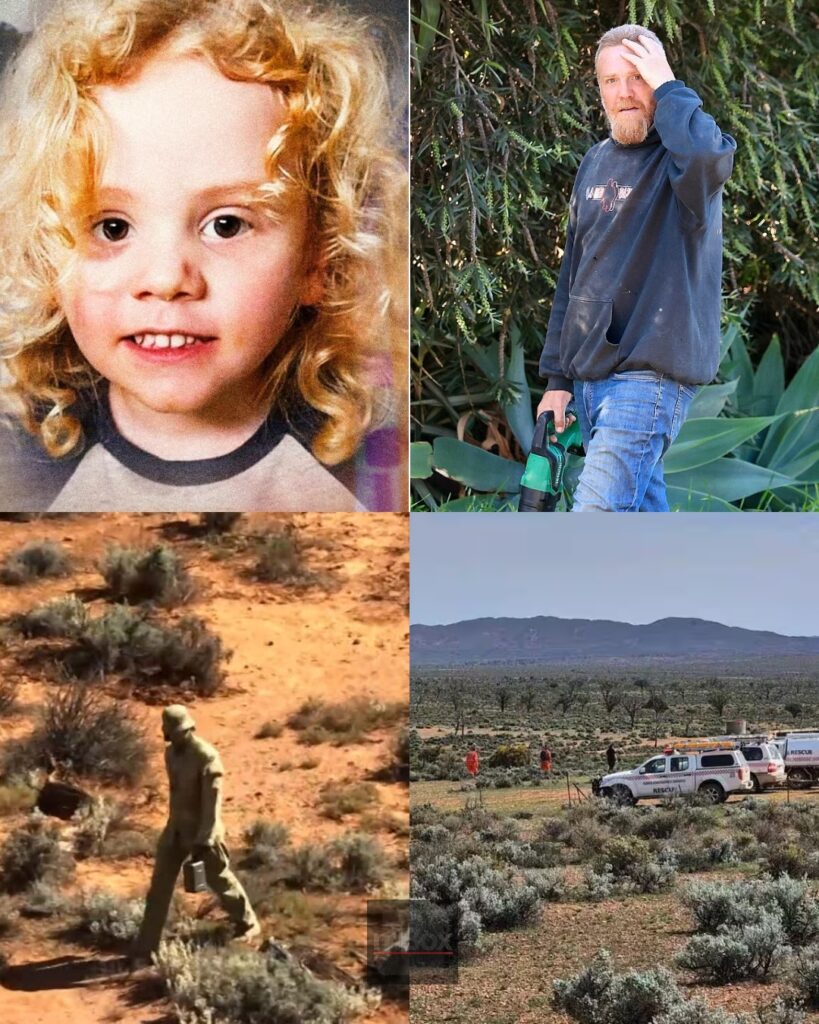
The disappearance of Gus Lamont has haunted South Australia for months, but a dramatic new development has shifted the case from a desperate search for a missing child to a full-scale criminal investigation. What began as a mysterious vanishing in one of the most remote parts of the Australian outback has now been officially declared a major crime — and police say they believe foul play was involved.
Gus Lamont, a four-year-old boy with blonde hair and a bright smile, vanished on September 27, 2025, from Oak Park Station, a sprawling sheep property near Yunta in South Australia’s harsh and isolated interior. According to initial reports, Gus had been playing outside near the homestead in the late afternoon. Within a short window of time — less than half an hour — he was gone.
At first, authorities treated the case as a missing child emergency. Given the unforgiving conditions of the outback — extreme temperatures, vast scrubland, abandoned mine shafts and dams — fears quickly grew that Gus may have wandered off and become lost. One of the largest search operations in the state’s history was launched. Police officers, State Emergency Service volunteers, Australian Defence Force personnel, helicopters, drones and specialist trackers scoured more than 95 square kilometres of rugged terrain. Nearby dams were drained. Mine shafts were examined. Every accessible corner of the property was searched repeatedly.
Yet despite weeks of effort, not a single confirmed trace of Gus was found. No clothing. No footprints definitively linked to him. No evidence he had walked away from the station. The silence of the landscape became increasingly troubling.
Now, months later, South Australia Police (SAPOL) have made a stunning announcement: the case has been officially declared a major crime investigation. Detectives say they no longer believe Gus simply wandered off or was taken by a random stranger. Instead, investigators suspect he was the victim of foul play.
Police have confirmed that a suspect has been identified — someone known to Gus and who was present at the property at the time of his disappearance. Authorities have not publicly named the individual, and no charges have been laid. However, detectives revealed that the person has stopped cooperating with the investigation and that inconsistencies in their account of events raised serious concerns.
Importantly, police have emphasized that Gus’s parents are not considered suspects. They remain devastated and are continuing to cooperate with investigators as they search for answers.
Detective Superintendent Darren Fielke explained that from the beginning, police considered three main possibilities: that Gus wandered off and perished in the bush, that he was abducted by a stranger, or that someone known to him was involved. After eliminating the first two scenarios based on extensive searches and the isolated nature of the property, investigators shifted their focus inward.
The declaration of a major crime marks a heartbreaking turning point. Police now say they believe Gus is no longer alive, though his body has not been found. The case remains active, and authorities continue to examine forensic evidence and follow new leads.
For the Lamont family and the wider community, the bombshell announcement brings both anguish and a grim sense of direction. What really happened that late September afternoon remains unanswered. But one thing is clear: the mystery that once centered on a missing child in the vast outback is now a criminal investigation, and police are determined to uncover the truth.