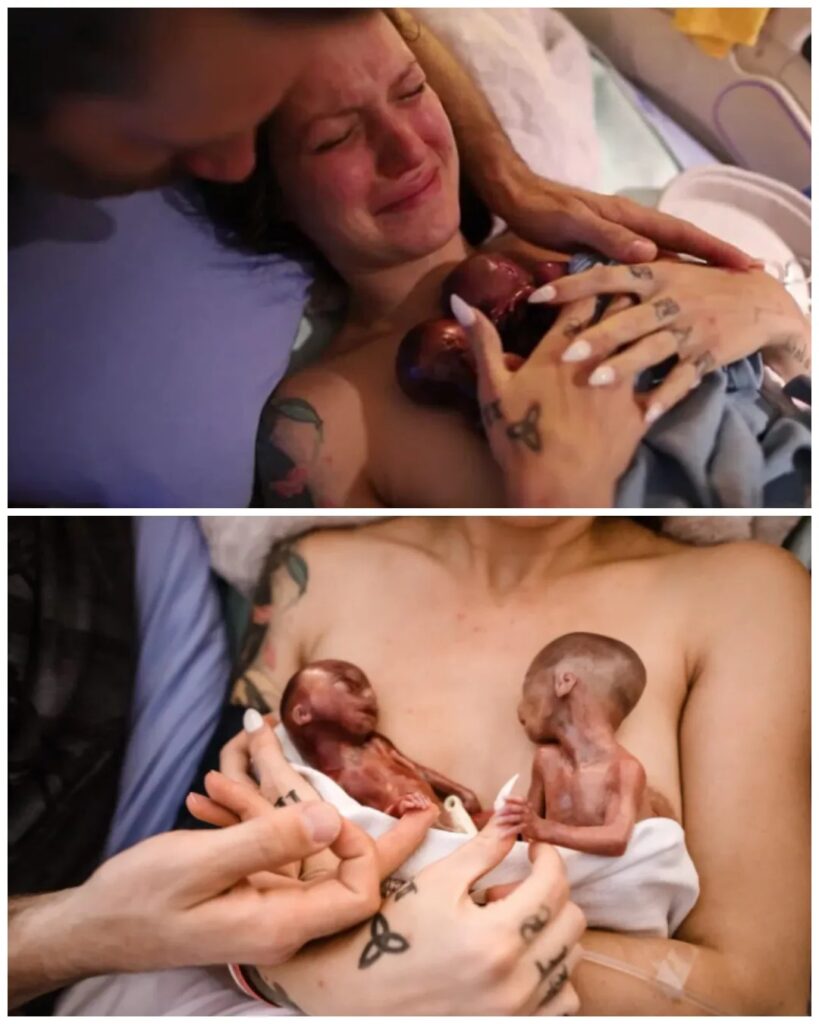
Thunder and Cloud were born alive.
They entered the world the way all babies do — gasping, stretching, fighting instinctively for breath. Their tiny chests rose and fell. Their fingers moved. They were not silent. They were not still. They were alive in their parents’ trembling hands.
Thunder weighed just 10 ounces. Cloud, slightly older in gestational age, weighed more but was still impossibly small. They were fragile, yes — but they were breathing. Their mother felt the warmth of their skin against hers. She saw their effort. She felt their will.
But a policy had already made a decision.
“Too early,” the doctors said.
Zero percent chance.
No intervention.
No attempt.
In that delivery room, hope collided with protocol. Their mother begged. She pleaded through tears, through shock, through the raw instinct that rises in every parent when their child is in danger. She wasn’t asking for miracles. She was asking for a chance — for oxygen, for a ventilator, for hands to try.
She held two living sons while medical staff stood back, bound by guidelines drawn along gestational lines and statistical outcomes. Somewhere in a chart, a number had outweighed the sight of two struggling newborns.
Minutes passed in unbearable slowness.
Thunder’s movements weakened. Cloud’s breathing grew shallow. Their mother whispered their names over and over, willing them to stay. She memorized every detail — the curve of their cheeks, the softness of their skin, the faint rhythm of their hearts against her chest.
And then, one by one, that rhythm faded.
The room that had held fragile possibility became unbearably quiet.
What haunts her is not only that they died.
It is that they were alive — and no one tried.
She has since learned that babies born at similar ages and weights have survived in other hospitals, in other cities, in other countries. With aggressive intervention, with specialized neonatal care, with teams willing to push against the odds, some have lived. Some are now children who run, laugh, and grow. Survival is not guaranteed — but neither is it zero.
That knowledge cuts deeply.
Because for Thunder and Cloud, the decision was made before their fight began.
Their mother carries both grief and questions. She wonders what might have happened if they had been born somewhere else. If a different hospital policy had drawn its line a few days earlier. If someone had chosen action over assumption.
She remembers the weight of them — so small, yet so real. She remembers that they breathed. That they moved. That they were sons, not statistics.
Policies are designed to guide care. They are built from data, survival rates, outcomes. But in the space between numbers and human life, there are moments that defy clean lines. There are babies who surprise doctors. There are parents who would accept any risk for even the smallest chance.
Thunder and Cloud lived for minutes.
They were held.
They were named.
They were loved fiercely in the short time they were here.
And for their mother, the deepest ache is not only their absence — it is the possibility that somewhere, under different rules, they might have been given the chance to stay.